
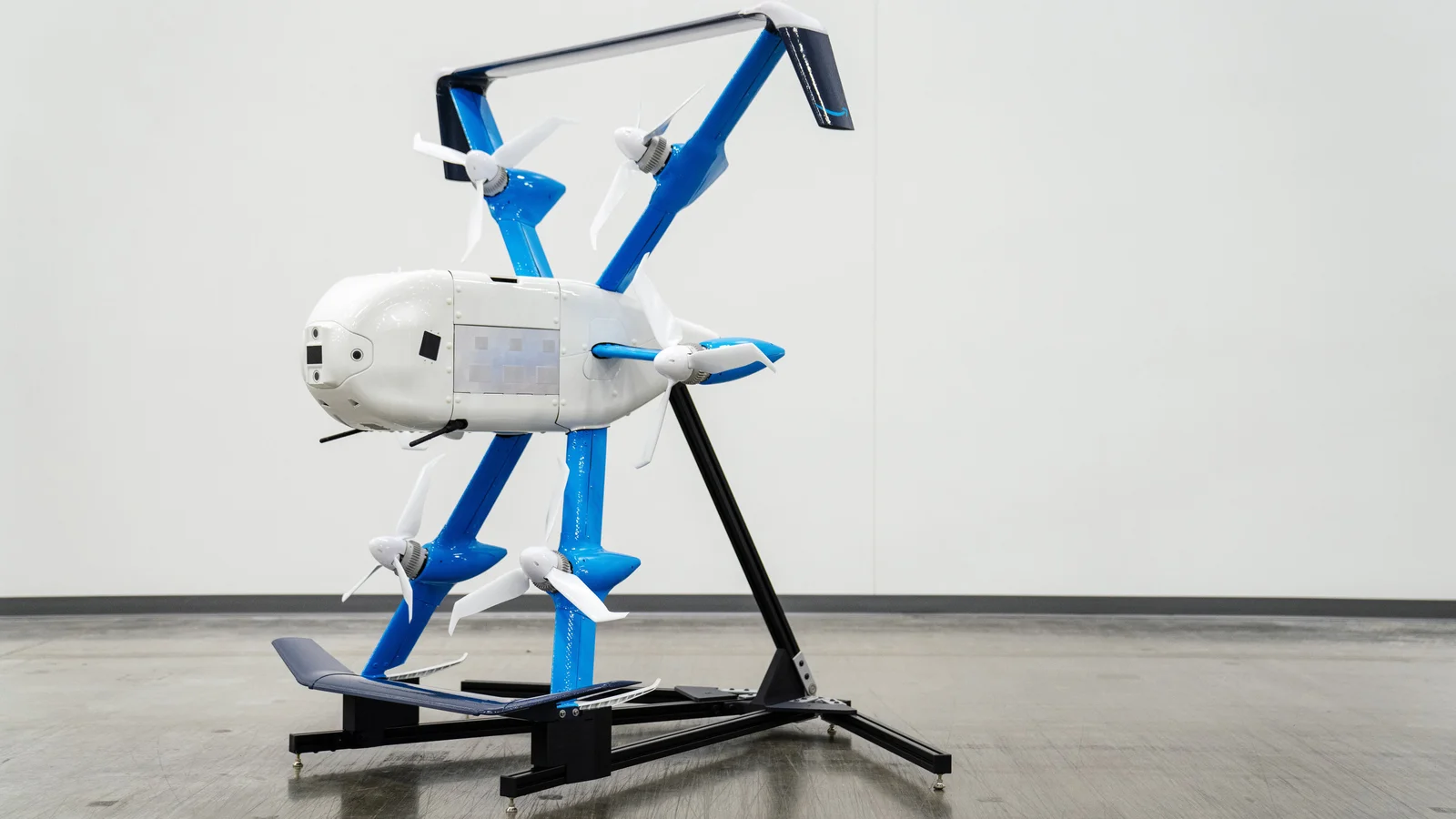
A fully built Amazon Prime Air MK30 on a laboratory stand, photographed for Amazon’s 2023 reveal. Photo: Amazon. This photograph does not show Bloomfield Hills. Image source.
Article by Richard Woods. Sources reviewed 24 September 2026.
A five-pound parcel is a modest payload for an aircraft with a maximum take-off weight of 83.2 pounds. That difference hints at the engineering behind Amazon’s MK30: propulsion, batteries, onboard perception and backup control systems must travel with every delivery. FOX 2 reported in August 2026 that service from Amazon’s Pontiac facility reaches Bloomfield Hills and Bloomfield Township. Availability depends on address eligibility. [1, 2]
For The Hardware Ledger, the interesting story is how Amazon developed a machine capable of repeating that journey. The MK30 brings together several difficult requirements: vertical take-off, efficient cruise, quieter operation, weather tolerance and autonomous decisions close to people and property.
From the early hybrid design to the MK30
The design has a long history behind it. Amazon’s 2019 delivery-drone announcement described a hybrid aircraft whose protective propeller shrouds also acted as wings. Vertical lift and wing-supported cruise were already central to the concept. The later MK30 would pursue those operating modes with a different airframe and a broader set of requirements. [3]
When Amazon revealed MK30 renderings in November 2022, it promised a smaller, lighter successor to the MK27-2, with greater range, broader temperature tolerance and the ability to fly in light rain. In October 2023, it showed the built aircraft, describing roughly 18 months of design and testing informed by years of work and dozens of prototypes. Those 18 months represent one development phase within a much longer programme. [4, 5]
The MK30 entered delivery service in Arizona and Texas in November 2024. Amazon says validating its aerodynamic and flight-control models took eight months before demonstrations with the full production hardware and software. That sequence matters: a promising airframe still needs evidence that its controls work across the intended flight envelope. [6]
MK30 specifications and the payload trade-off
The FAA’s Detroit assessment describes six electric motors, staggered wings and a rechargeable lithium-ion battery. The aircraft lifts off vertically, then transitions to wing-borne flight. Its published figures establish the scale of the platform. [2]
| Characteristic | Published figure |
|---|---|
| Maximum payload | 5 lb / approximately 2.3 kg |
| Maximum take-off weight | 83.2 lb / approximately 37.7 kg |
| Maximum operating radius from the hub | Up to 7.5 miles / approximately 12 km |
| Maximum cruise speed | 73 mph / approximately 117 km/h |
| Normal parcel release height | Approximately 13 ft / 4 m above ground |
Source: FAA Detroit assessment. Converted units rounded. [2]
The engineering rationale is straightforward. Vertical lift suits compact launch and delivery areas; wings support the aircraft during cruise. Integrating those modes creates a control problem: the aircraft must remain stable through transitions and after releasing its payload. At maximum take-off weight, the permitted parcel accounts for about six per cent of total mass. That ratio illustrates the support hardware required to move a small package, although it cannot establish energy efficiency by itself. The operating radius is not the total round-trip distance or a guarantee that every address inside it is eligible.
Explore mass allocations with THL’s Payload and MTOW Calculator. It is a general planning tool, not an MK30 model.
Propeller noise and battery requirements
Propeller development addressed another constraint: sound. Amazon says custom propellers reduced the MK30’s perceived noise by almost half compared with earlier models, while the aircraft doubled their range. These are company comparisons, not independent measurements. For the designers, noise joins thrust, efficiency and structural durability as a requirement. A drone intended to visit the same neighbourhood repeatedly needs its acoustic performance considered from the outset. [5]
Battery engineering is less visible in Amazon’s public material. The reviewed sources identify lithium-ion propulsion, but do not disclose pack capacity, voltage, cycle life or charge time. Those omissions limit any independent calculation of delivery economics. The engineering questions include how much energy remains after the outbound flight, descent and hover, and what reserve is available for returning or handling a disrupted mission. [2]
For a general check on energy and average-power assumptions, use the Electric UAS Endurance Estimator. Its results are not validated MK30 performance estimates.
Ground handling is part of that system. At Amazon’s Darlington site in England, staff install a charged battery before each flight and visually inspect propellers, struts and motors. This provides a concrete example of how the aircraft is prepared for repeated service. Battery handling, inspection time and component replacement will influence how much useful work each airframe can perform. [7]
The delivery mechanism and onboard sensing
The payload mechanism is equally purposeful. The FAA describes an internal two-door receptacle that releases the parcel while the drone remains airborne, approximately 13 feet above ground. Amazon’s Darlington account also describes cushioning built into the bottom of the delivery box. The aircraft’s release mechanism and the package’s impact protection therefore form one delivery system. [2, 7]
Perception hardware connects the aircraft to a changing environment. Amazon describes onboard cameras identifying obstacles and other aircraft. Its explanation of contingency landings specifically identifies cameras and radar assessing people, objects and terrain before a contingency landing. That distinction matters: evidence of radar-assisted ground assessment does not establish a published radar detection range for other drones. Sensor coverage, detection distance and processing latency remain important questions when assessing the system’s capabilities. [8, 9]
Backup flight controls and failure testing
The flight computers provide another layer. Amazon says a separate monitoring computer watches the primary flight-control algorithm. If it detects anomalies, it can transfer control to a backup controller and initiate a return to base. Hardware redundancy becomes useful when the aircraft can recognise a failure and complete that handover while remaining controllable. [6]
Amazon’s development tests deliberately stopped motors, electronic speed controllers or propellers, and disabled the primary flight computer to check backup operation. It repeated failure tests in vertical and horizontal flight and at different mission stages. These are more demanding questions than whether an undamaged prototype can complete a demonstration: the tests examine what happens when part of the machine stops doing its job. [10]
Rain, dust and operating limits
Weather capability also required physical testing. Amazon describes submerging spinning motors and spraying the aircraft from different angles and at different pressures. That work supported the MK30’s light-rain capability. It should be understood as evidence of a specific development programme, rather than an unrestricted all-weather rating. [6]
Development continued after launch. In its updated 2025 testing account, Amazon said dust could interfere with an altitude sensor’s readings. The company reported pausing the fleet, making enhancements, retesting and receiving FAA approval before resuming service; it said it had not experienced a related safety event in service. The account does not identify the sensor type or exact modification. It does show how operating experience can expose conditions that require further engineering. [10]
What the delivery rollout shows
The rollout supplies evidence of operational use. On 19 August 2026, Amazon reported hundreds of thousands of drone-delivered packages during the year and listed 11 US operating locations, including Pontiac. That is meaningful progress beyond prototype demonstrations. Judging hardware maturity more fully would require completion rates, battery replacement data, maintenance hours and weather-related availability alongside delivery totals. [11]
What Part 107 operators should understand
For Part 107 operators, the hardware has a direct regulatory consequence. The MK30’s weight exceeds Part 107’s definition of a small unmanned aircraft: less than 55 pounds at take-off, including its load. Prime Air instead operates under Part 135 authority with associated exemptions and approvals. Its growing presence also raises the value of dependable detection and traffic coordination. Other drone pilots cannot assume that onboard automation guarantees their aircraft will be detected. [2, 12]
The MK30 shows how much development sits behind a small parcel arriving by air. Its progress rests on aerodynamic refinement, propeller design, failure-tolerant controls, sensing and the practical work of preparing an aircraft for its next flight. The next measure of success is how reliably those components keep working together through repeated missions, changing conditions and years of service.
Sources
Sources checked on 24 September 2026. Manufacturer performance claims are attributed in the article.
- FOX 2 Detroit — Pontiac facility and communities served
- FAA — Detroit final environmental assessment, May 2026
- Amazon — Earlier hybrid drone design, 2019
- Amazon — MK30 design reveal, November 2022
- Amazon — Built MK30 and development background, October 2023
- Amazon — MK30 launch and engineering, December 2024
- Amazon — Darlington battery handling, inspection and packaging
- Amazon Prime Air — MK30 technology and onboard perception
- Amazon — Contingency landing hardware and sensing
- Amazon — Failure testing and altitude-sensor improvements, updated 2025
- Amazon — Network expansion and delivery totals, August 2026
- eCFR — 14 CFR Part 107 scope and small-unmanned-aircraft definition