
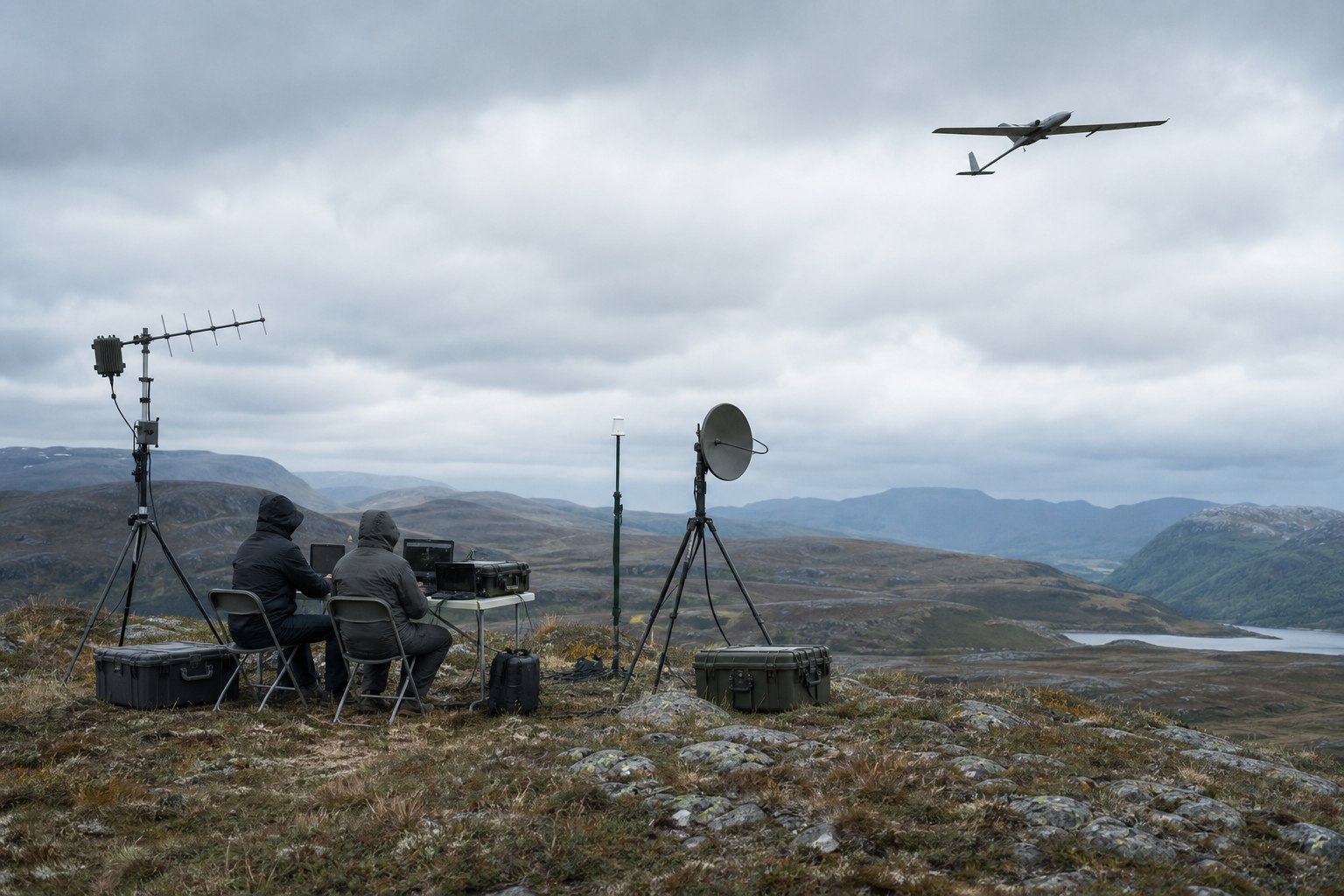
Technological progress in unmanned aviation is often described as linear improvement: longer endurance, better sensors, greater autonomy. Yet recent conflicts suggest a different pattern. Under sustained operational pressure, development compresses. Architectures that cannot tolerate contested conditions are exposed quickly and displaced. The dynamic is less evolutionary ascent than accelerated filtration.
History offers a precedent. During the Second World War, combat aircraft did not improve simply because designers pursued aerodynamic elegance. They adapted because attrition exposed structural weaknesses. Range, survivability, and protection were not aesthetic refinements; they were corrective responses to operational loss. The introduction of long-range escort fighters such as the North American P-51 Mustang was driven by bomber attrition over Europe. Heavily armoured ground-attack aircraft such as the Ilyushin Il-2 Sturmovik reflected the cost of exposure to concentrated anti-aircraft fire. Iteration speed was dictated by consequence.
A similar compression is visible today in unmanned systems.
The Russia–Ukraine war: spectrum and navigation as selection engines
The Russia-Ukraine War has provided large-scale empirical evidence of what sustained spectrum contestation does to UAS architecture. Persistent GNSS denial and spoofing have exposed reliance on single-source positioning. Systems designed around stable satellite navigation assumptions have experienced degraded mission reliability, navigation drift, and loss of return-to-home functionality.
The response has been rapid and pragmatic rather than visionary. Increased integration of inertial navigation, multi-constellation receivers, antenna diversity, and shorter mission profiles has become commonplace. Manual terminal guidance has supplemented autonomy where necessary. The lesson is structural: PNT resilience is no longer an enhancement; it is foundational.
Communications architecture has undergone similar filtration. High-throughput digital links, optimised for sensor payload performance, have proven vulnerable under broadband jamming and direction-finding pressure. Survivable systems increasingly favour frequency agility, reduced bandwidth tolerance, distributed mesh networking, and physical separation between operators and forward nodes. Field modification cycles measured in weeks – not years – now influence architecture.
These adaptations were not introduced because they were technologically fashionable. They were adopted because fragility carried immediate operational cost.
Nagorno-Karabakh: integrated kill chains and air defence exposure
The Nagorno-Karabakh conflict offers a complementary example. The 2020 conflict demonstrated the integration of ISR drones and loitering munitions into tightly coupled strike complexes. Persistent ISR compressed kill chains. Static or poorly concealed air defence systems were progressively exposed and degraded.
The decisive factor was not drones in isolation but system integration: sensors, fires, and information operations operating in concert. Nevertheless, air defence architectures optimised for legacy threat models encountered sustained unmanned pressure that revealed emitter predictability, mobility constraints, and concealment weaknesses.
In effect, persistent unmanned-enabled targeting acted as a stress test. Systems unable to manage emissions, relocate rapidly, or integrate effectively with ISR networks were selected against. The filtration mechanism was operational attrition.
The Middle East: cost exchange and coverage geometry
Events in the Middle East reinforce a different but related pressure. The Abqaiq–Khurais attack demonstrated how low-altitude precision threats can exploit coverage geometry and readiness assumptions, producing strategic effect disproportionate to platform cost. Defences oriented towards expected threat axes or optimised for higher-altitude targets were exposed to low-flying systems exploiting radar blind spots and terrain masking.
Subsequent regional campaigns involving cross-border drone and missile strikes have highlighted the importance of cost exchange ratios and industrial resilience. Low-cost systems, iteratively refined, can impose high defensive expenditure and compel constant adaptation. Replacement velocity – the ability to regenerate capability faster than it is attrited – becomes a strategic variable.
The pressure here is economic as much as technical. Architectures that are exquisite but slow to replace are vulnerable in environments where saturation and repetition are viable tactics. Conversely, modular, rapidly manufactured systems gain relevance.
Cross-theatre patterns
Across Europe and the Middle East, several structural patterns recur.
First, navigation resilience and spectrum survivability determine operational reach. Without them, endurance and payload performance are moot.
Second, integration outweighs platform-centric optimisation. A drone linked into an effective ISR-to-fires loop exerts influence beyond its individual specifications.
Third, simplicity under stress often outperforms complexity optimised for benign conditions. Field adaptability – the ability to modify antennas, firmware, or employment profiles quickly – is increasingly valuable.
Fourth, industrial and logistical resilience matter. The capacity to absorb losses and regenerate capability shapes strategic endurance.
In each theatre, survivability under contested conditions has outweighed peacetime refinement priorities.
Iteration velocity as a strategic variable
The most striking difference between peacetime development and conflict-driven adaptation lies in feedback velocity. In controlled environments, iteration cycles often span years and are governed by certification, budgeting, and programme milestones. In conflict, feedback is immediate and consequential. Weeks can separate fielded modification from combat validation.
The dynamic echoes WWII aviation, but at greater speed. Data is generated at scale. Weak assumptions are punished rapidly. Architectures either absorb the lesson or are displaced.
This does not imply that peacetime development is misguided. It reflects different structural incentives. Optimisation for efficiency, safety, and cost control produces refinement. However, refinement does not automatically equate to resilience under contested conditions.
A measured strategic implication
It is widely acknowledged within defence communities that peacetime acquisition frameworks differ from wartime realities. Recent conflicts simply reinforce the technical observation that architectures validated primarily against procedural compliance may not experience sufficient stress to reveal latent fragility.
The challenge is not to replicate wartime attrition. It is to replicate, as far as practicable, the consequences that drive adaptation. Testing regimes that incorporate degraded navigation, spectrum congestion, and logistic friction can accelerate learning without requiring operational loss to trigger it.
This is not a novel insight. It is a structural one, grounded in observable conflict data.
Conclusion
From the adaptation of WWII combat aircraft to contemporary UAS in Ukraine, the Caucasus, and the Middle East, a consistent pattern emerges: capability matures most rapidly when weakness carries immediate operational cost.
Peacetime refines systems. Conflict filters them.
The acceleration of UAS adaptation across multiple theatres suggests that survivability under contested conditions is now the primary determinant of enduring relevance. Architectures that internalise this dynamic early – through realistic stress exposure and rapid iteration loops – are likely to mature faster and fail less publicly than those reliant solely on incremental optimisation.
In unmanned airpower, as in earlier eras of aviation, progress is rarely smooth. Under pressure, it is selective.